

The Oak Knoll Flock

Indian Ringneck/Rose Ringed Parakeet
Puff Dad
Arrived: 2001 Passed Away: 2025
Moved to Bird Kingdom
Fun fact: I used to live with my mate Puff Mom, a yellow (or Lutino) Rose-Ringed Parakeet, but unfortunately she passed away in 2019. We did however give birth to a baby while at The Hamilton Aviary who was named Puff and so we got our names after she was born.
Species Fact: Another name for this bird is the Indian Ringneck. However, it is only adult male birds that have the black and rose ring under their beaks. The females and young birds do not have this characteristic.
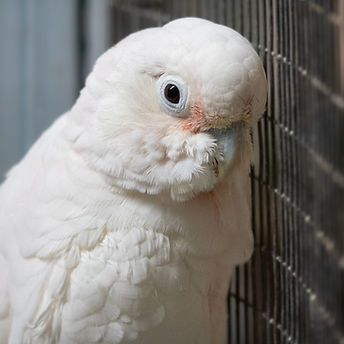
Goffin's Cockatoo
Snowball
Born: 2005 (at The Aviary)
Moved to Bird Kingdom
Fun fact: I play Peek-a-boo, Stick em up (raise my wings), and will stick out my tongue!
Species Fact: Unfortunately in Indonesia where Goffin's are from they are considered a crop pest and are persecuted. In some areas they are even considered food.

Umbrella Cockatoo
Jessie
Born: 1997 Arrived: 2001
Moved to Bird Kingdom
Fun fact: I originally lived in the Westdale neighbourhood but was surrendered to The Aviary after my owners received numerous noise complaints.
Species Fact: Cockatoo's are popular companion birds thanks to the film and television industry (shows like Baretta made people interested in owning a pet bird) but they are not recommended for first time bird owners.

Sulphur Crested Cockatoo
Tia
Born: 2000 Arrived: ####
Moved to Bird Kingdom
Fun fact: I love being talked to, pet on my head, and asked to do my trick - Big Wings! I also enjoy dancing to Bruno Mars' Uptown Funk, marching around, and ringing my bell!
Species Fact: Citron-Crested Cockatoo are one of the rarest cockatoos in the world! They can only be found on the small Indonesian island of Sumba.

Goffin's Cockatoo
Howard
Born: 1970s Arrived: 2002 or prior
Moved to Bird Kingdom
Fun fact: Before The Aviary closed I was the only bird with a direct relative, my daughter Snowball lived down the hall from me.
Species Fact: Goffin's Cockatoos are naturally very curious. Combined with the dexterity in their feet, beak, and tongue, they make excellent explorers and innovators. They are so smart that we even use tools to access their favourite foods.

Eastern Rosella
Rosey
Born: 2006 Arrived: 2007
Moved to The Toronto Zoo
Fun fact: Volunteers often referred to me as Howard's girlfriend because I often sat close to him in my enclosure. I also love digging in hanging plants.
Species Fact: This little bird has lots of names including Eastern Rosella, Redheaded or White-cheeked Rosella, Golden Mantle, Polly Parrot, Rosehill Parakeet, and Rosy.

Cockatiels
Maddy, Baldy, and the Tiels
Born: early 2000s
Moved to Bird Kingdom
Fun fact: Cockatiels have little orange patches on their cheeks. One of FOTA's Cockatiels looks like his are shaped like hearts!
Species Fact: Did you know that Cockatiels are the smallest members of the Cockatoo family? Cockatiels got their scientific name from the first Europeans to see them. Early settlers thought they were so beautiful that they named them after the nymph, a mythical creature.

Galah/Rose Breasted Cockatoo
Rosie
Born: 2009 (at The Aviary)
Moved to The Toronto Zoo
Fun fact: I was born at The Aviary to parents Len and Marie. I was often a favourite of many visitors and volunteers because of my beautiful colours and favourite phrase "buh-bye!"
Species Fact: The name Galah is actually of Aboriginal origin. It comes from the Yuwaalaraay word for 'clown', a name these birds earned for their playful antics. Today the Aboriginal name is used in preference to Rose-breasted cockatoo, the name given by Europeans.
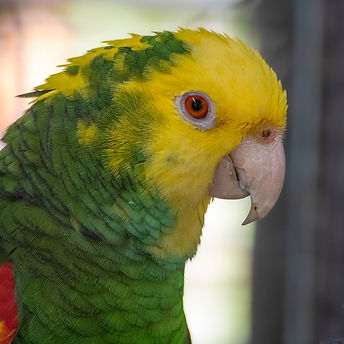
Double Yellow Headed Amazon
Mya
Born: 1980s-1990s Arrived: 2008
Adopted by a Volunteer
Fun fact: I can say Hello and Mya, make siren, baby, and cat noises and sing the opening note to Alouette.
Species Fact: Did you know there are 33 different types of Amazon Parrots alone? They all have green bodies, but normally have an extra colour or two that separates them from each other. Many of them are named by what colour they are other than green and where that colour is (Orange-Winged, Blue-Fronted, Red-Lored, etc).

Blue and Gold Macaw
Bubbette
Born: 2000 Arrived: 2004
Moved to Bird Kingdom
Fun fact:
Species Fact: Macaws can blush! Scientists believe that blushing, along with facial feather fluffing is a way for birds to communicate their emotions. Colour is usually a key component in visual communication systems and represents the beginning of parrot 'facial expressions'.

Blue and Gold Macaw
Billie
Born: 1994 Arrived: 1996
Moved to Bird Kingdom
Fun fact: I am a gentle giant. Although I did not allow handling, I happily explored outside of my cage, did some training, and accepted treats.
Species Fact: When it comes to the age of companion birds, the general rule of thumb is the bigger the bird, the longer they could live. Blue & Golds and other macaws are the largest companion birds and have been recorded living up to 115 years although that is not the norm.

Congo African Grey
King
Born: 2010 Arrived: 2014
Adopted by a Volunteer
Fun fact: I can only say "Hello" but love to mimic sound effects like the doorbell, alarm system, telephone ringing, text tones, clicks and squeaks, and more!
Species Fact: African Greys are actually the biggest parrot in all of Africa! CAGs are among the smartest birds in the world and are the best at mimicking human speech. Although, this doesn't mean every African Grey Parrot will talk

Zebra Finches
Born: 2015-2025
Moved to The Toronto Zoo
Fun fact: Zebra finches have been kept in captivity for over 100 years. They may be the most popular finch, but there are about 10 other species that can be kept in captivity. This includes the brightly coloured Gouldian Finch, Owl Finch, and Strawberry Finch.
Species Fact: Zebra Finches are considered a "beginner"or "hands-off" bird because they should be housed with at least one other bird to keep them company. However, if trained they can do tricks just like larger parrots and benefit from enrichment like foraging opportunities!